How Do I Get ChatGPT to Know About My Business?
Businesses are increasingly discovering that customers use ChatGPT to search for services, compare companies and ask for recommendations. Unlike Google Search Console or a traditional business directory, there is no simple “submit my business to ChatGPT” button, instant indexing request or ChatGPT business console.
Improving your chances of being discovered starts with understanding where ChatGPT retrieves business information, then making your company clear, consistent, useful and verifiable across the sources it may encounter.
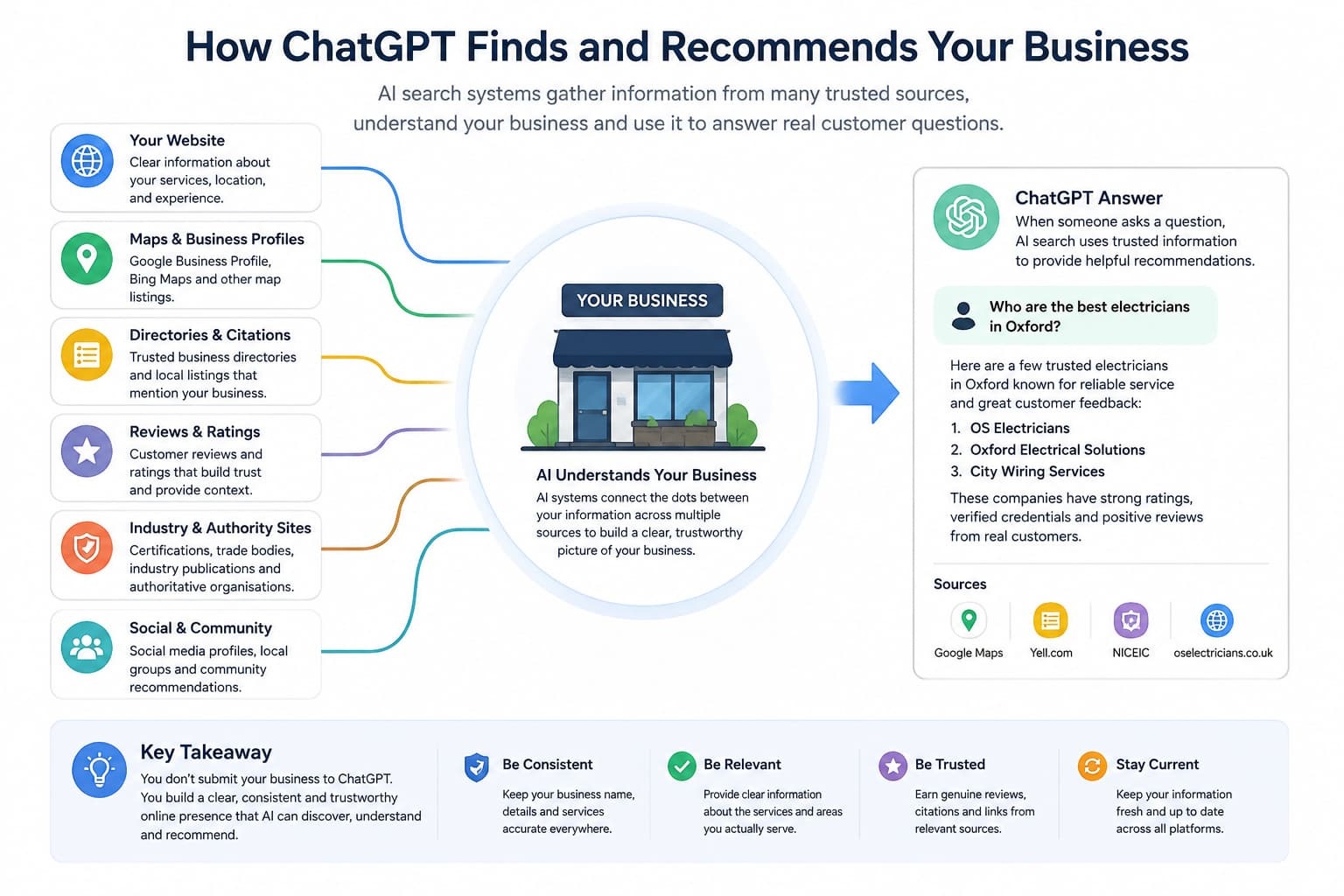
Start by investigating what ChatGPT already finds.
Observational research is one of the most useful ways to understand how AI search behaves in your industry and location.
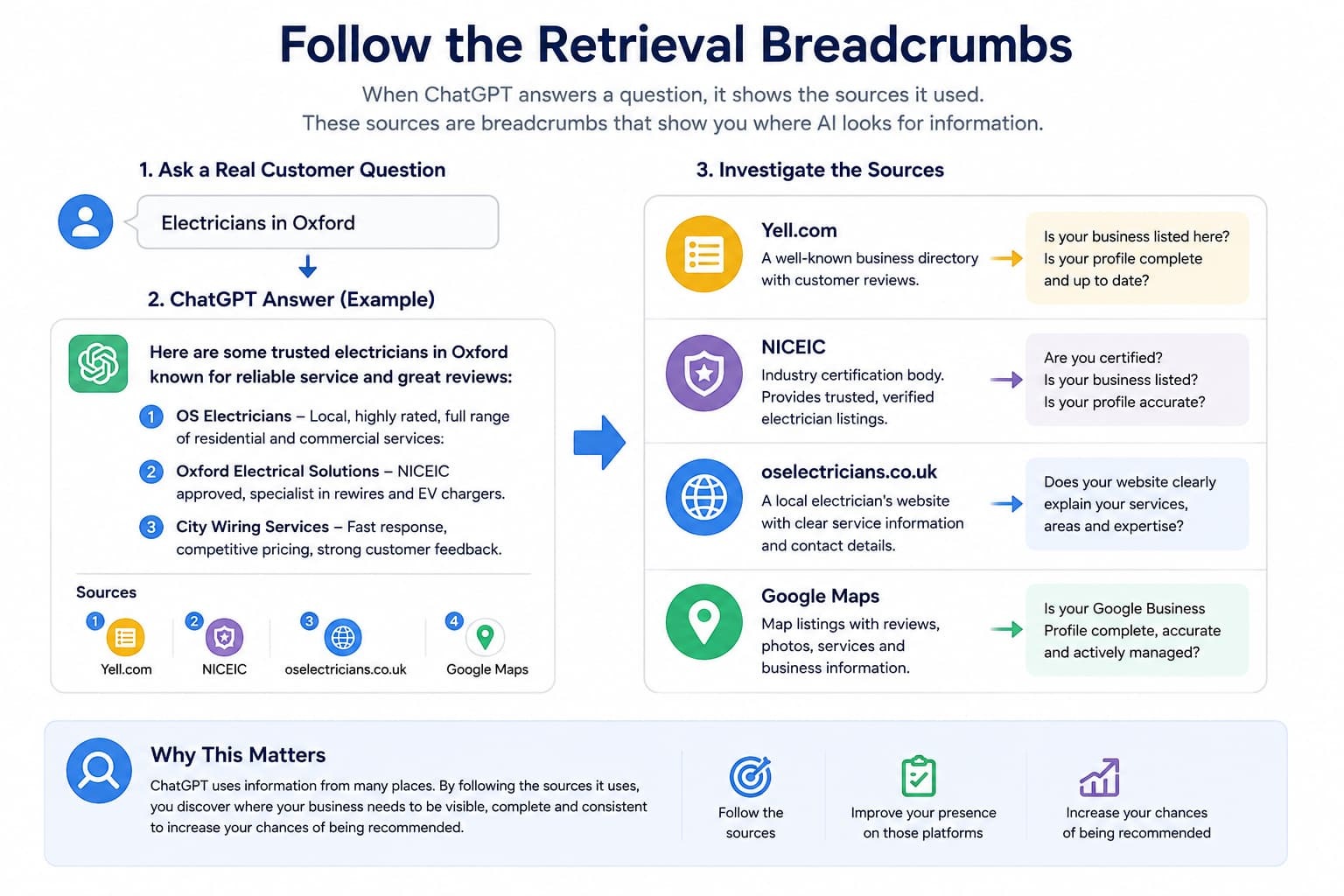
Follow the retrieval breadcrumbs
Imagine you are an electrician operating in Oxford. Search something a customer might genuinely ask, such as “Electricians in Oxford.”
Do not only look at the businesses mentioned. Inspect the sources shown alongside the answer. Was it a local directory, certification body, business website, map listing, publication or community source?
Those sources are useful breadcrumbs. If ChatGPT repeatedly retrieves a particular kind of source for that query, investigate whether your business can legitimately establish a presence there too.
Being listed on the same websites does not guarantee a recommendation. It does give you evidence about the information environment being retrieved.
Don't ask whether ChatGPT knows you. Ask whether it finds you.
Branded searches and unbranded customer searches test two very different things.
There is a major difference between asking “Tell me about OS Electricians” and asking “Who can wire a garden room in Oxford?”
“Tell me about OS Electricians.”
“Who can add electrical sockets to a loft in Oxford?”
The first gives ChatGPT the business directly. The second requires the system to discover relevant businesses itself. Use realistic, unbranded questions and record which businesses appear and which sources support the answer.
Make your business entity clear.
Consistency helps AI systems resolve information from different websites back to one real business.
One business should look like one business
A company officially called OS Electricians but described elsewhere as Oxford Specialist Electricians can create unnecessary ambiguity if the relationship between those names is not made clear.
Your website, Google Business Profile, Bing Maps, directories, Facebook page and important third-party references should reinforce the same core information.

Reviews provide more than a star rating.
Detailed customer feedback can create a customer-backed information layer around the services a business actually performs.
“Great company. Five stars.”
“OS Electricians installed the electrics for our new garden room, including additional sockets, lighting and an outdoor supply.”
Both are positive, but the second carries far more factual information about the company's work. Compare the depth, recency and relevance of competitor reviews, not only the headline star rating.
Relevant authority beats collecting links for the sake of it.
Backlinks can provide useful relationships, but their relevance and evidential value matter more than chasing a raw total.
A reference from a recognised certification organisation, trade body, respected industry publication or authoritative local source can provide much more meaningful context than large numbers of unrelated links.
A general local website may provide worthwhile exposure. But a specialist industry or certification source can provide stronger topical evidence when the question is specifically about qualified professionals.
Google ranking does not automatically equal ChatGPT visibility.
Traditional search ranking and generative AI retrieval are different mechanisms.
A business can rank extremely well in conventional search and still appear inconsistently in generated recommendations. ChatGPT can retrieve different sources and respond differently to detailed, conversational questions.
This is why AI visibility should be tested independently using realistic prompts rather than inferred from Google positions alone.
Make your website explicit about what you actually do.
Customers ask AI systems detailed questions. Give retrieval systems detailed, factual information to work with.
“Professional electrical services throughout Oxford.”
“We install domestic EV charging points throughout Oxford, including assessment of the existing electrical supply and installation of the required dedicated circuit.”
Customers might ask about garden-room electrical connections, additional plug sockets, loft electrical work, EV chargers, consumer-unit replacement, outdoor lighting or kitchen alterations.
Do not force an AI system to infer a specialist service from a broad category. Say clearly what you actually do.
This is where Answer Engine Optimisation (AEO) becomes useful: clear, grounded and factual information can create extractable summarisation frames that AI systems can identify, interpret and use when answering detailed enquiries.
Claims are easy. Evidence is better.
Transparent qualifications, registrations and authoritative verification can turn a marketing statement into something that can be independently checked.
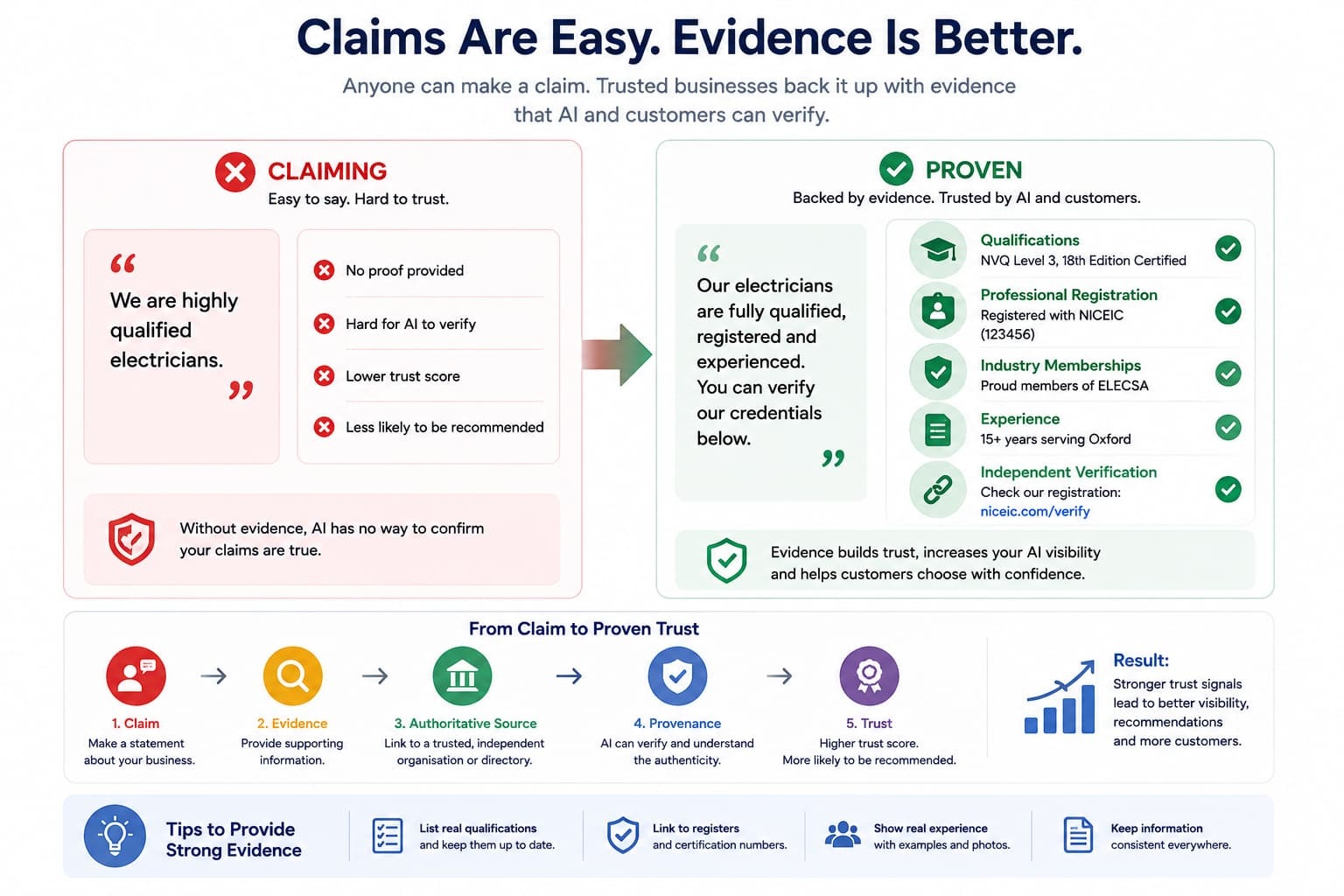
Build a provenance trail
Anyone can write “We are highly qualified electricians.” A genuine professional can often support that claim with qualifications, registrations, memberships, experience and links to authoritative sources where important credentials can be checked.
For AI systems attempting to provide safe and useful recommendations, independent corroboration can help distinguish a marketing claim from information backed by evidence.
Keep your information current and accessible.
Visibility is not a one-time exercise. Businesses change, and retrieval systems need access to the version that exists today.
Does schema help ChatGPT understand my business?
Yes, it can help clarify machine-readable relationships, but structured data is not the same thing as independent proof.
Schema.org markup can express relationships such as organisation → service → location → qualification → person → website.
But adding structured data that says a company holds a qualification does not by itself prove that qualification exists.
The strongest approach is clear visible information + structured data + verifiable evidence + consistent third-party information.
Observe, improve and test again.
There is no single switch that guarantees a business will be recommended by ChatGPT.
AI search systems evolve, retrieval sources change and different questions can create very different information pathways.
Run realistic unbranded searches. Record who appears. Inspect the sources. Compare profiles and websites. Identify missing information. Improve it. Then test again.
Over time, this observational process gives you a more useful picture of how your business is represented in AI search than relying on assumptions about how ChatGPT should work.
Want help improving how AI systems discover your business?
David Marketing Specialist offers a free initial AI visibility consultation. We can review how your business is represented, inspect the sources and competitors appearing for relevant searches, identify information gaps and explain practical improvements.
Our work can include business-profile management, entity consistency, website information, relevant third-party references, structured data, Answer Engine Optimisation (AEO), Generative Engine Optimisation (GEO) and wider AI visibility strategies.